
Syrian Voices
Part of the Humanities Cultural Programme, one of the founding stones for the
future Stephen A. Schwarzman Centre for the Humanities.
Primary Investigator
Mehreen Saigol
Partner Organisations:
“I think it’s good in this research that you’re doing that you are giving people a platform to express themselves as they wish to be seen or considered.” (Yazan, Syrian Voices Participant)
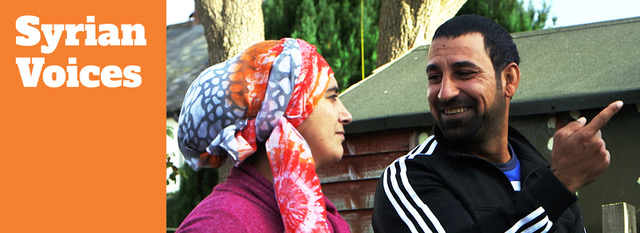
SYRIAN VOICES was a community history and documentary film project that explored the Syrian crisis from the unique perspectives of refugees who had settled in the UK.
The project responded to the urgent need to witness the humanitarian catastrophe through individual stories of conflict, diaspora and perceptions of life in the UK. Syrians from diverse backgrounds and all walks of life candidly shared their experiences. Using filmed testimonies, Zoom recordings, home videos and photographs, Syrian Voices offered an insight into what it meant to be a war refugee living in the UK.
Contact:
Syrian Voices: info@syrianvoices.org.uk
Contact:
Syrian Voices: info@syrianvoices.org.uk
A play with the working title Pastures Green was developed in response to the Syrian Voices project. It incorporated many elements of the lived experiences of the Syrian diaspora in the UK, creating a unique story centred around two Syrian women living with a fifteen-year-old boy in a flat in Manchester. The women were waiting for the arrival of a man, Mahdi, who had yet to make the long journey from Syria to the UK but whom they believed would arrive imminently.
There was a knock on the door, but instead of Mahdi, Nadia, an independent journalist, arrived. She had met Mahdi while making her own hazardous journey to the UK and had news for the two other women, (Yara and Rima).

On the 26th May the Playground Theatre, in London W10, kindly gave the Pastures Green group the space to hold an R&D or workshop day. For the workshop four actresses were invited alongside a number of writers and film makers.
Taking the rough treatment (outline of the story so far) and putting it on its feet to interrogate the premise of each scene, as well as to resolve some loose ends was the plan for the day.
First the group, all of whom had read the treatment, discussed the characters adding colour and detail. Next a number of sections were chosen, and the actors took each scene and improvised around it. Most importantly, the purpose was not to write the dialogue but to see where the obvious conflicts were with the characters and to texture to the interactions.
We used different techniques, like running scenes with the women’s characteristics exaggerated to find the essence of their personalities as well as changing their actions and desires.
Key to this story is illustrating what it feels like to be living as a refugee in the UK and to highlight the strength of the people who have had to flee their own country. At the same time, the range of characters and personalities shows the audience that this could be any of us and that no one choses to be a refugee.

That said we want the piece to have as much humour as possible and the workshop was fantastic in helping us find some of these moments. One of them is in the use of Arabic. The character of Rima hates speaking English and so we looked at her only speaking Arabic but then we tried an idea where she initially speaks in Arabic only to Yara who asks her to please speak English. Rima then immediately switches to fluent English saying she hates English. This establishes that when she is speaking fluent English that is in fact her speaking Arabic. It works well for comic effect.

I could write about this for hours. So much wonderful stuff came out of this very intense day, and we will repeat the process once all that we discovered has been absorbed into the initial treatment. The next step is to start to write the script. We spoken to two excellent Syrian writers, who we hope will collaborate with us for this next bit of the journey.

Amanda Waggott June 2021

